Edu de Barros — Looping
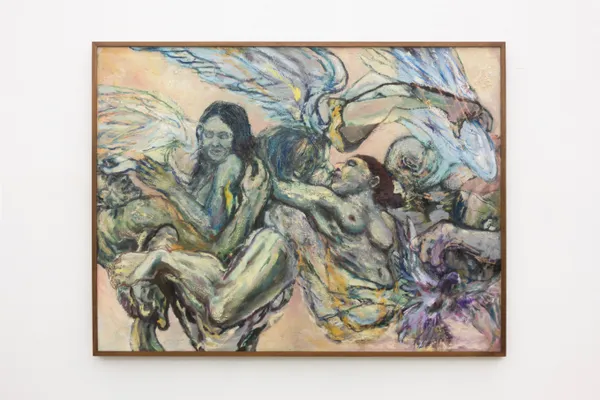
![Edu de Barros Arrebatamento, 2024 Óleo sobre madeira [Oil on wood] 170 x 165 cm (Díptico) [66 7/8 x 65 in] (Diptych)](https://static-assets.artlogic.net/w_800,h_800,c_limit,f_auto,fl_lossy,q_auto/artlogicstorage/galeriaathena/images/view/7969ac3675ef92590574bb8bb6c7715aj/galeriaathena-edu-de-barros-arrebatamento-2024.jpg)
[Oil on wood]
[66 7/8 x 65 in] (Diptych)
In Looping, his first solo exhibition in Rio de Janeiro, Edu de Barros presents a new body of paintings, sculptures, and installations organized around a non-linear conception of time. Here, history does not unfold in progression but in cycles: images return, reconfigure themselves, and contaminate one another, allowing biblical episodes, apocalyptic fabulations, and signs of contemporary culture to coexist.
The artist’s practice is structured through the friction between seemingly distant symbolic fields. Elements of Christian iconography coexist with esoteric references and urban signs, composing a hybrid visual language in which the sacred and the profane cease to function as opposing categories and instead become inseparable instances. Within this unstable terrain, visions such as a tropicalized apocalypse, angelic raptures, or extraterrestrial apparitions over Latin America emerge less as fixed allegories and more as projections of an ever-shifting imaginary.
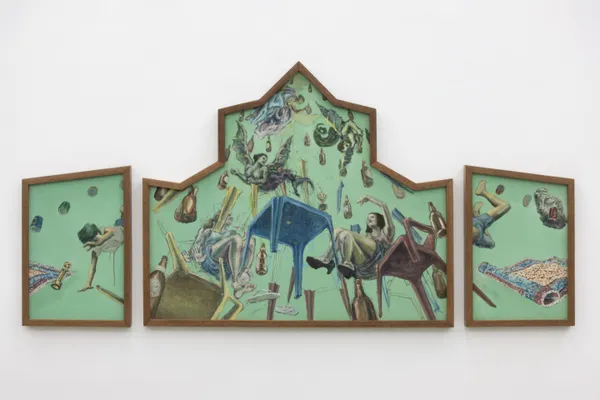
Formally, this instability manifests in the construction of figures. Foreshortened bodies, abrupt perspectives, and vertiginous framings produce a sense of continuous displacement, as if the viewer were being thrown into a collapsing narrative. Within these images lies a persistent ambiguity between ascent and collapse, between the promise of transcendence and the imminence of ruin. Heaven and hell cease to be distant realms and instead insinuate themselves as simultaneous states, in which the everyday infiltrates the extraordinary.
The Retábulos series makes this operation explicit by reappropriating a classical device from the religious tradition, one that carries its own linguistic codes. Historically linked to the organization of sacred narratives in sequential structures, the altarpiece is here displaced into a subjective field, where intimate episodes, ordinary characters, and fantastic figures share the same symbolic plane. By tensioning this format, Edu de Barros not only revisits a visual grammar but reinscribes it as a tool for constructing a contemporary imaginary.
The exhibition further expands into the architectural space of the gallery. Suspended within the environment, a vaul, evoking cathedrals and mosques, extends the spatial experience of the show. Throughout the exhibition period, the painting of this structure is carried out by the artist within the space itself, relocating the studio into the gallery and incorporating the time of execution as a constitutive element of the work.
Between images that return and transform, between narratives that overlap and dissolve, Looping proposes a state of vertigo, an incessant movement that, in turning upon itself, destabilizes any fixed point and invites us to inhabit this interval.